Recognising Prostate Cancer Awareness Month
NEW GUIDELINES TO HELP MORE MEN GET PROSTATE CHECKUPS
This prostate cancer awareness month, the message from GV Health is simple:
Know your risk, talk to your GP, and don’t wait for symptoms before having a conversation.
This year, Australia has new national guidelines for the early detection of prostate cancer. The new guidelines, developed by the Prostate Cancer Foundation of Australia, replace those from 2016.
They set out how often and when a prostate specific antigen (PSA) blood test should be offered, while preventing over-diagnosis for asymptomatic men.
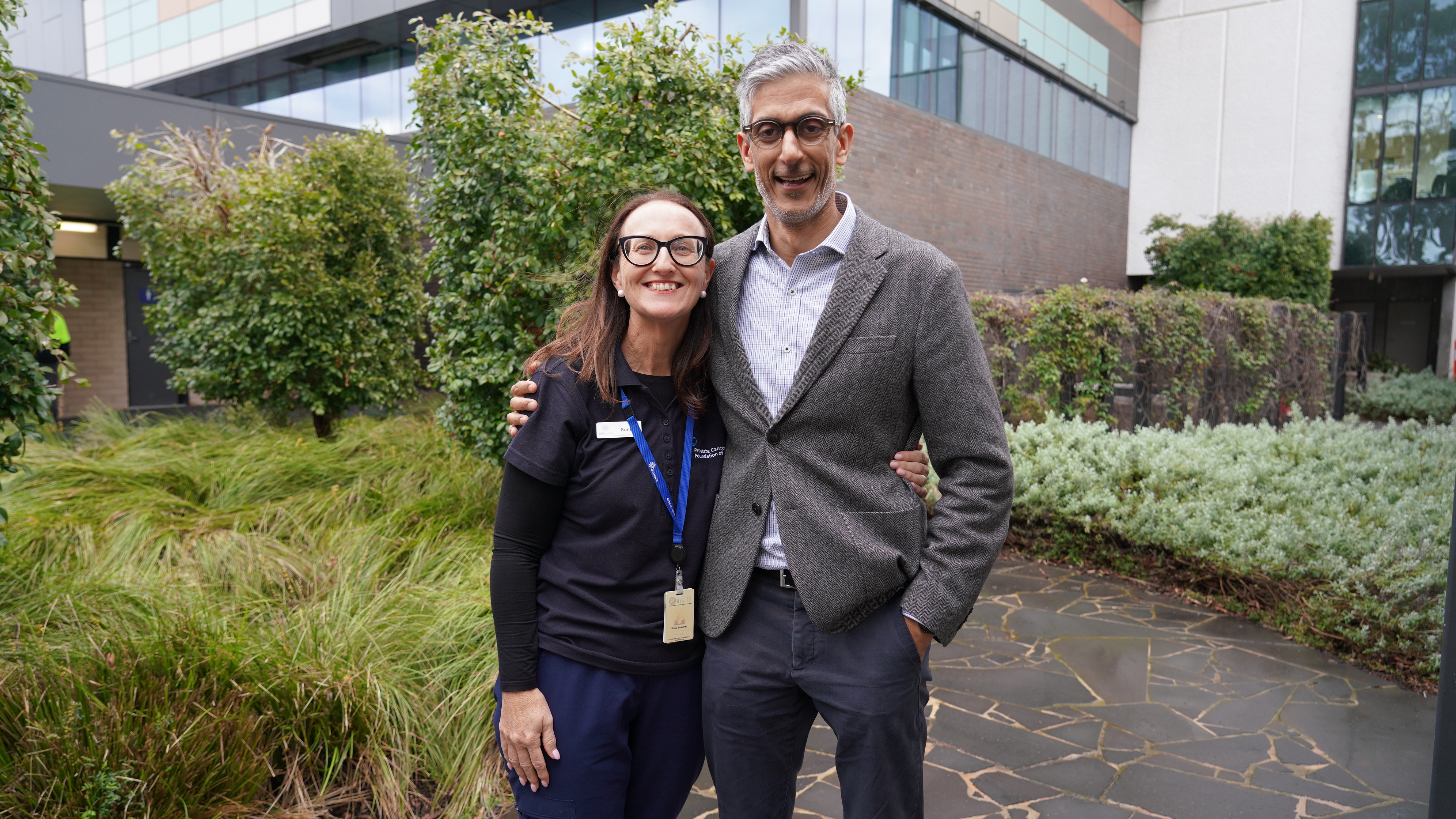
GV Health Urologist, Kapil Sethi, said new clinical guidelines make big changes to screening, with an end to the digital examination and more frequent PSA tests.
“We always just used to have a blood test for a long time, but now, as part of our pathway, which we discuss with our patients, we offer them imaging before potentially doing a biopsy, and then through shared decision making, we decide whether they need treatment or not,” Kapil said.
Previously, many men were expected to initiate the conversation themselves. Now, the guidelines recommend that GPs initiate that discussion.
The guidelines also recommend GPs to offer PSA testing from age 45 instead of the previous recommendation of age 50.
“Those at high risk are more likely to have an aggressive form of the cancer at a younger age due to family history, including certain people who might have a breast cancer mutation that might run in the family,” he said.
The guidelines have also moved away from the digital rectal examination, advising it is not required to be offered by GPs as a routine addition to a PSA test.
“Digital rectal examination caused a lot of confusion amongst GPs and is something that a lot of patients were hesitant to have done,” he said.
“Currently, this examination would be primarily done by a urologist if needed, while further investigations such as magnetic resonance imaging (MRI) would give us some really good information.”
From a community perspective, GV Health Prostate Cancer Specialist Nurse, Sonia Strachan, said GPs initiating the discussion would ease the anxiety around diagnosis, encouraging men to also talk to one another.
“A prostate cancer diagnosis can be an overwhelming experience for men and their families as they navigate complex healthcare decisions,” Sonia said.
“There are still too many men dying every year of prostate cancer when this is a very curable disease.”
Prostate cancer is estimated to be the most diagnosed cancer in Australia and last year itself there were an estimated 4,000 deaths, while roughly 28,000 were diagnosed, according to the Australian Institute of Health and Welfare.
The new guidelines identify higher-risk groups, including men with Black sub-Saharan ancestry, a BRCA2 mutation, or a strong family history of prostate cancer. They recommend PSA testing every two years from age 45, with lower thresholds for follow-up.
“Early detection is so important, and the earlier we diagnose these men with prostate cancer, much better the chance of survival,” Sonia said.
“Also, we’re lucky being a very multicultural community, as a lot of our healthcare professionals and interpreters are able to speak several languages and communicate things.”
Research by Prostate Cancer Foundation of Australia confirms the need for more information to be communicated in culturally sensitive ways to facilitate increased awareness and understanding.
GV Health’s Prostate Cancer Specialist Nurses Sonia and Nicole are available to provide advice and information, help coordinate care, arrange referrals and offer emotional support for patients and families navigating a prostate cancer, from diagnosis and treatment options to survivorship.
Patients and families can self-refer and contact Sonia and Nicole directly by phone, email or in-person.